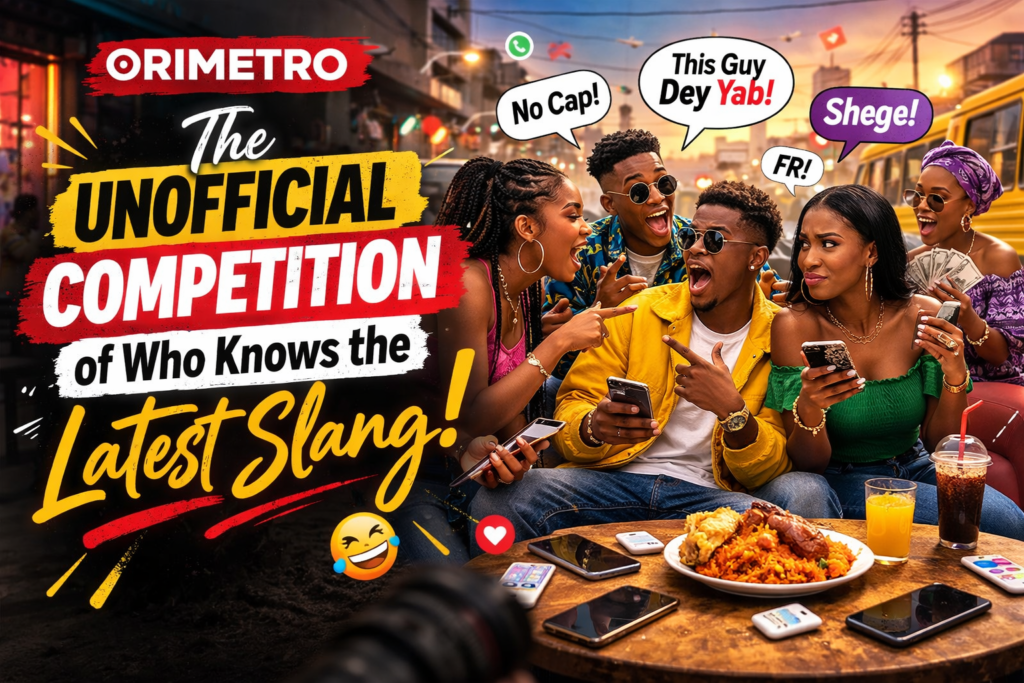
If you listen carefully to conversations among young Nigerians today, you will notice something interesting. Language is moving at the speed of WiFi. New slang appears almost every week. One minute, everyone is saying a particular phrase, and the next minute, the internet has already moved on to something new. But the most fascinating part is not the slang itself. It is the unofficial competition that comes with it.
Because in many Nigerian friend groups, knowing the latest slang is not just about communication. It is about status. The moment a new phrase appears online, a silent race begins. Someone must be the first to use it in real life.
Not awkwardly.
Not cautiously.
But confidently, like they have been using it since childhood. The true winners are the people who drop new slang casually in conversation, as if the words simply arrived naturally in their vocabulary. Everyone else hears it and immediately starts doing mental calculations. “Wait… when did that one start?”
Social media is usually where the race begins. A phrase appears in a tweet. Someone repeats it in a TikTok video. Then suddenly the word spreads through group chats, captions, and random conversations. Within days, the slang becomes a cultural passport. If you understand it, you are current. If you do not understand it, you are dangerously close to sounding outdated. And nobody wants to be the person asking, “What does that mean?”
Of course, there are different categories of slang users.
First, you have the early adopters. These people somehow know every new phrase before anyone else. They use slang with the calm confidence of someone who lives inside the internet. They never explain the meaning. They simply say it and move on, leaving the rest of the group confused but pretending to understand.
Then there are the fast learners. These may not discover the slang first, but once they hear it, they adopt it immediately. Within two days, they are already using the phrase in captions, voice notes, and conversations as if they had personally invented it. They study the rhythm carefully. They observe how others say it. Then they deploy it strategically.
But the most entertaining group is the late adopters. These are the people who finally learn a slang word when the internet has already started retiring it. They begin using the phrase enthusiastically, repeating it everywhere with great excitement. Meanwhile, everyone else has quietly moved on to the next expression.
It is a tragic, yet very common cycle.
Part of the reason slang spreads so quickly in Nigeria is that the culture thrives on creativity. Music influences it. Comedy influences it. Street culture influences it. Social media amplifies everything. A single phrase from a song, a viral video, or even a random tweet can suddenly become part of everyday language. And before you realize it, people are using the phrase in conversations that have absolutely nothing to do with its original meaning.
The funny part is how seriously some people take the competition. You will see someone deliberately dropping slang into a sentence that barely fits it, just to prove they are aware of the trend. The delivery might be slightly forced. The timing might be questionable. But the mission is clear. They must not be seen as outdated. Because in today’s digital culture, being behind on slang feels like showing up to a party where everyone already knows the inside joke except you.
But eventually, every slang word faces the same fate. It becomes too popular. Parents begin using it. Older relatives start asking what it means. Brands start adding it to advertisements. And once that happens, the internet quietly retires the phrase and moves on to the next one, leaving everyone scrambling again.
So the next time someone casually drops a slang word you have never heard before, just relax. Do not panic. Do not rush to Google it. Just nod slowly and observe. Because chances are, in a few weeks, another completely different phrase will arrive. And the unofficial competition will begin all over again.
Now be honest. Who is that friend that always knows the latest slang before the rest of the group even hears it.